

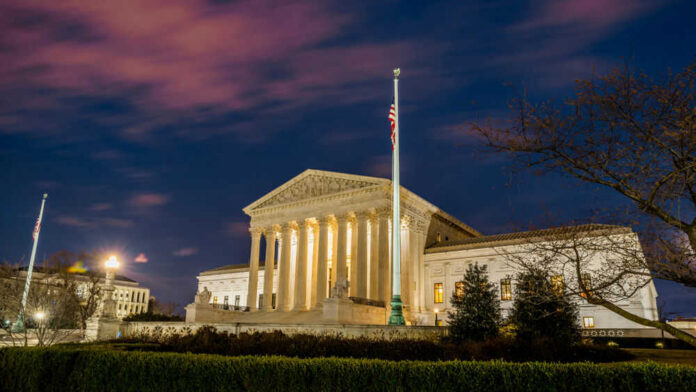
Chief Justice John Roberts just gave President Trump’s $400 million White House ballroom a temporary green light while the Supreme Court decides its fate.
Quick Take
- Chief Justice Roberts allowed construction on the $400 million White House ballroom to continue “for now” as the Supreme Court weighs an emergency request.
- A federal appeals court had ruled 2-1 that only Congress can authorize the project, upholding a lower court’s order to halt work.
- The National Trust for Historic Preservation says the administration has no legal power to build without Congress signing off first.
- Senate Republicans, led by Lindsey Graham, are pushing a bill to fund the ballroom and settle the fight legislatively.
What Roberts Actually Decided
Roberts did not rule on who wins. He issued a short-term administrative stay, letting crews keep working on the demolished East Wing site while the full Supreme Court considers Trump’s emergency request.
The order buys time. It does not settle whether a president can knock down part of the White House and rebuild it without asking lawmakers first, a question that has bounced through federal courts since spring.
Supreme Court chief justice allows work on Trump’s $400M White House ballroom to continue for nowhttps://t.co/4HBmPx7mKM
— Phil Stripling (@civex) August 21, 2026
How This Fight Started
The dispute began after the administration tore down the East Wing to make room for a 90,000-square-foot ballroom.
The National Trust for Historic Preservation sued, arguing neither the president nor the National Park Service had authority to demolish or rebuild without Congress weighing in. In March, Senior U.S. District Judge Richard Leon agreed, halting the project until lawmakers approved it.
The administration appealed, but lost again in August. A divided panel of the U.S. Court of Appeals for the District of Columbia Circuit ruled that “each president is a temporary tenant, not the owner” of the White House, and cannot reshape it without Congress’s blessing.
That ruling upheld the injunction blocking further work, setting up the current Supreme Court showdown.
The Administration Pushes Back
Trump’s solicitor general asked the Supreme Court to let construction continue while the appeal plays out, arguing the lower courts got it wrong. The administration frames the ballroom as a needed upgrade to White House event space, not a legal overreach.
Roberts’s temporary order keeps the project alive, but it is far from a final victory, and the underlying legal battle over presidential authority is still unresolved.
Preservationists Say the Law Is Clear
The National Trust has not backed down. In its Supreme Court filing, the group said the administration “has no unilateral legal authority—constitutional, statutory, or otherwise—to build a ballroom on the site of the now-demolished East Wing, unless and until Congress expressly approves.”
That argument has won at every court level so far, which is why the administration is now leaning on the Supreme Court as its last shot.
Trust President Brent Leggs has repeated the same message since the case began: only Congress can authorize construction of a ballroom at the White House.
That consistency matters. Courts tend to respect arguments that do not shift with each ruling, and so far, judges at both the district and appellate level have sided with that reading of the law.
Congress Tries to Solve It Legislatively
While courts fight it out, Senate Republicans are trying to end the debate outright. Lindsey Graham introduced the White House Safety and Security Act, which would appropriate the full $400 million for the project and frame it as a security upgrade rather than a vanity build.
Graham has pointed to a recent assassination attempt near the White House as proof the building needs modernized security infrastructure.
That bill matters because it could make the entire court fight moot. If Congress formally appropriates the money and authorizes the work, the National Trust’s core legal argument disappears overnight.
Until then, the fight stays in the courts, with the Supreme Court now holding the pen on whether bulldozers keep running at the White House.
Why This Case Reaches Beyond One Building
This is really a fight over how much power a president has over federal property without Congress in the room. Courts have leaned hard toward requiring explicit congressional sign-off for major changes, echoing similar battles over national monuments and federal land.
A win for the administration here would reset that balance in a way that outlasts any one ballroom.
Sources:
apnews.com, congress.gov, abcnews4.com, reuters.com, pbs.org