
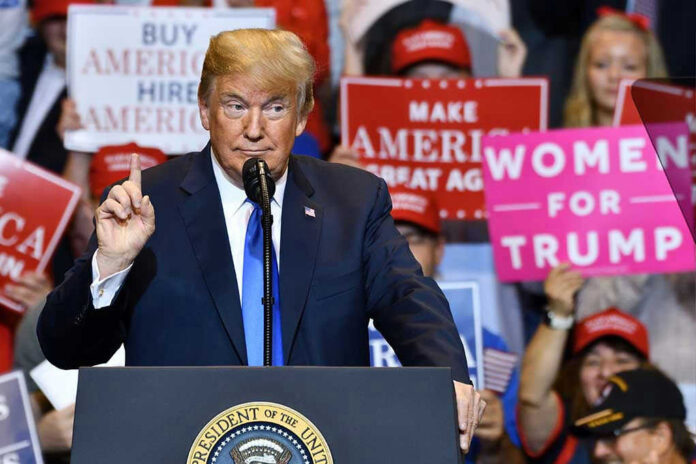
President Trump said he could be the last Republican president if Democrats gain full control and “lock in” power, a warning he tied to communism and a market crash.
Story Snapshot
- Trump told rally crowds Democrats would cement one-party rule with structural moves.
- He branded Democrats a communist threat and said communism is the “greatest danger”.
- He argued Democrats would impeach him again if they take the House.
- Analysts link such fear warnings to a well-known global campaign pattern.
Trump’s Case: A Final Republican Presidency If Democrats Consolidate Power
President Trump told supporters in Ohio that if Democrats win the White House and take both chambers of Congress, he “will be the last Republican president.” He said Democrats would add senators and House seats, capture the courts, and make rule changes that tilt elections for good. He placed this claim inside a larger warning that one-party control would threaten free markets and faith in elections. The line set the tone for his case: beat them now, or lose the country’s balance.
BREAKING: Trump has said: "I will be giving all adult citizens in the US $5000. Democrat policies will not allow this happen… they will raise your taxes. If Democrats win, you will have an ecomomic depression. If Republicans win, you will have $5000 in your pocket."
— unusual_whales (@unusual_whales) October 12, 2026
Trump linked the risk to economics, warning that markets cannot thrive under heavy central control. He argued that policy built on government-directed energy, credit, and labor would choke small business and retirement savings. He tied that risk to a 1929-style collapse if fear drives capital out of productive work. His view aligns with conservative basics: growth needs clear rules, stable money, and limited government. He said Democrats’ agenda puts all three at risk, fast.
Communism Charge And Why He Thinks It Lands
Trump called Democrats “communist,” not just “socialist,” and said that ideology is the most serious threat to the United States. He framed the party’s platform as state-first, hostile to faith, hostile to free speech, and eager to punish dissent. He used past failures of command economies as proof. The soundbite was sharp by design and matched his recent rally scripts, where he claims the left moved past European-style welfare policy into hard-line control of society and markets.
His charge drew fast coverage because it crosses a rhetorical line. Reporters often flag it as an exaggeration, while also noting that Democrats reject the label. Still, the message sticks with crowds who see speech codes, green mandates, and prosecutorial overreach as steps toward state dominance. That fear animates older voters who remember the Cold War and younger business owners who face rising compliance costs. Trump speaks to both with one label and one risk picture.
Impeachment As A Live-Fire Example Of What Unified Control Means
Trump told voters that a Democrat House would impeach him again. He framed impeachment as a tool the other side now uses on repeat to weaken elections they fail to win. He urged voters to treat midterms like a presidential ballot for this reason. The point was simple: if Republicans lose the House, Democrats will use process to reverse policy wins, stall judges, and harass the executive branch with endless probes and subpoenas.
That claim fits a pattern from his earlier exchanges with the press, where he shrugged that he was “getting good at it,” then flipped back to a warning that process fights distract from growth and border security. The audience takeaway is practical: control Congress to avoid policy whiplash. Conservative readers will recognize the underlying logic. Stable rules drive investment. Endless investigations spook lenders, crush hiring plans, and slow wage growth. Elections decide which path wins.
Why The Message Works: Fear Framing Moves Votes
Research across 101 countries found that fear appeals surge in close, high-stakes races. Candidates at the edges of the spectrum use them more. The reason is tactical. Fear breaks habits and makes people consider switching sides. That is why “communism,” “court packing,” and “last Republican president” are sticky phrases. They aim to compress a complex policy fight into a single, urgent choice: keep freedom and markets, or lose them to a party that will lock power down.
That dynamic does not prove any forecast right on its own. It explains why the pitch is blunt and why it can change turnout. Trump ties the fear to specific levers: elections law, court size, energy policy, speech rules, and federal police powers. He says those levers, used together, would harden one-party control and drain the economy. The case aligns with conservative common sense: free people, free prices, and free speech rise and fall together. He is telling voters they must defend all three now.
Sources:
mediaite.com, newsbreak.com, reuters.com