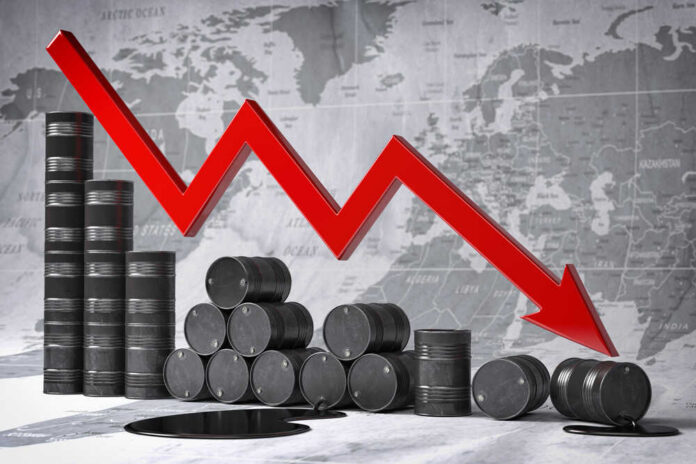
Brent crude sliding below $76 is not just a market chart move; it is a stress test of Trump’s promise that cheaper oil should mean cheaper gasoline for real people, right now.
Story Snapshot
- Brent crude has dropped to its lowest level since the eve of the U.S.-Iran war, driven by diplomacy and sanctions relief, not charity.
- Trump says oil companies “should” cut gasoline prices, but there is no law forcing them to move a single penny at the pump.
- A well-known “rockets and feathers” pattern means gas prices jump fast and fall slow, frustrating drivers even when crude collapses.
- Deep supply, demand, and refinery dynamics may keep gasoline high even as Brent and West Texas Intermediate slide.
Oil prices fall sharply as war fears ease and Iranian crude returns
Brent crude futures have broken below $76 per barrel, their lowest level since the day before the U.S.-Iran war, as traders bet that more oil will soon reach global markets.[12] West Texas Intermediate crude fell under $75 by June 22 after starting the month above $90, a huge swing in just three weeks.[4]
This drop did not come out of nowhere. The U.S. Department of the Treasury issued a 60-day general license that allows transactions in Iranian-origin crude, signaling that barrels long locked out by sanctions could flow again.[2]
At the same time, early ceasefire and framework deals between the United States and Iran began reopening traffic through the Strait of Hormuz, easing fears that tankers would stay stuck behind mines and naval blockades.[5][6]
Energy analysts describe this as a classic supply shock in reverse: war premiums drop, risk hedging unwinds, and futures prices sink as buyers expect more oil and smoother shipping lanes over the next few months.[2][5]
JUST IN: 📉 Brent crude oil falls to $75, its lowest level since February. pic.twitter.com/QQXzkoieip
— The Market Journal (@MarketJournalX) June 24, 2026
Fortune’s real-time price snapshots show just how fast this reversal hit the screens of traders and fund managers.[7] On the morning of June 22, Brent traded around $79.25 a barrel. By that evening, prices had sliced through $75, a decline of more than $3 from the prior day.[7]
Trading desks report large speculative positions rushing for the exits once diplomatic headlines looked credible, accelerating the slide in both Brent and West Texas Intermediate contracts.[4] Market watchers have seen this movie before: once a war scare fades and fresh supply appears, the fear premium evaporates faster than most consumers can refresh the gas-price app on their phones.[3]
The Energy Information Administration notes in its short-term outlook that as Middle East production recovers, it expects Brent prices to fall toward the high $80s later in 2026 and into the $70s in 2027, pointing to a longer glide path away from triple-digit oil.[8]
Trump’s pressure campaign runs into legal and economic reality
Trump has seized on the crude oil decline to argue that gasoline prices should drop now and that oil companies have a duty to cut pump prices for American drivers. His message fits a familiar pattern: presidents publicly scold energy firms when prices spike or stay stubbornly high, hoping pressure alone will move the numbers on station marquees.[1][4]
But there is no statute, executive order, or court ruling that requires refiners or gas retailers to pass crude price declines through on a fixed schedule or at a fixed rate. The president can urge, threaten future regulation, and jawbone, yet he cannot set gasoline prices by decree in a free market system.[16][19]
Industry leaders do not hide their skepticism. Oil and gas executives recently warned the White House that low fuel inventories could push gasoline prices much higher, even above five dollars per gallon, despite any short-term crude moves.[17]
They point to shrinking commercial stocks, a Strategic Petroleum Reserve at the lowest levels in decades, and tight refinery capacity as reasons why pump prices may not track Brent or West Texas Intermediate step for step. Consumer advocates and economists echo another concern: the famous “rockets and feathers” effect.
Gasoline prices shoot up quickly when crude rises, but they fall slowly and partially when crude drops.[10] That lag frustrates drivers and gives firms room to protect profit margins while public attention fades. From a common-sense view, this looks less like a sinister plot and more like businesses reacting to risk, costs, and competitive pressures—not to presidential tweets.
Why falling crude does not guarantee cheaper gasoline for drivers
Gasoline is not crude oil poured straight into your tank. It is a refined product that reflects global supply and demand, refinery operations, taxes, and local competition on top of the base oil price.[13]
Wikipedia’s summary of oil pricing reminds readers that global supply and demand drive crude prices, not any single country’s production alone, which means U.S. policy wins only limited control over final consumer prices.[13]
A study of historic oil price swings during the Covid-19 pandemic shows how economic policy uncertainty and market volatility can push prices around even when barrels are plentiful, breaking any simple “crude down, gas down” rule.[14]
The Energy Information Administration’s forecasts warn that wholesale gasoline prices could still rise in 2026 even under some scenarios where crude eases, because refining margins, regulations, and seasonal demand add their own layers of cost.[8]
That mix of forces undercuts both Trump’s suggestion that companies can cut prices instantly and the idea, popular on social media, that any delay proves pure greed. Markets can be unfair, but they are rarely simple.
History also shows that presidential pressure sometimes nudges behavior on the margins but rarely rewrites the laws of economics. Research on gasoline politics during earlier oil shocks found that the threat of tougher regulation pushed some large companies to hold refined-product prices down temporarily.[19]
Those episodes were exceptions, not the rule. Today, with global oversupply building and analysts projecting Brent possibly drifting toward the $60 to $65 range by early 2027, firms may slowly trim gasoline prices as risk premiums fade and competition bites.[3][9]
Yet they will do so on their own timetable, guided by inventory data, refinery schedules, and shareholder demands—not because Trump declares on television that prices “should” fall.
For drivers watching Brent crash while station signs barely budge, the lesson is hard but clear: cheaper crude is necessary for cheaper gas, but it is not enough. Until policy, supply, and refinery realities line up, the gap between the oil chart and the pump total will remain—and politicians of every stripe will keep promising more than the market is built to deliver.
Sources:
[1] Web – Brent falls below $76, notching its lowest level since day before …
[2] Web – Price of Brent Crude Oil Falls Below $76 Per Barrel for 1st Time …
[3] Web – 2026 Brent Crude Price Outlook: Falling Below $80, Where Is the …
[4] Web – Price of Brent Crude Oil Falls Below $76 Per Barrel for 1st … – …
[5] YouTube – WTI Crude Oil futures fell below $75 as speculators exited. 6/22/26
[6] Web – Crude Oil Brent Jun ’26 Futures Price – Barchart.com
[7] YouTube – Crude Oil Prices By July-August Would Be At $85/Bbl
[8] Web – Current price of oil as of June 22, 2026 – Fortune
[9] Web – Short-Term Energy Outlook – EIA
[10] Web – Oil prices to decline as global oversupply builds through 2026: US EIA
[12] Web – Why Aren’t Gas Prices Dropping? – Bell Performance
[13] Web – Oil Price Forecast for 2026 | J.P. Morgan Global Research
[14] Web – Price of oil – Wikipedia
[16] Web – Will fuel prices drop with brent crude? – Facebook
[17] Web – What can a president do to significantly lower gas prices? – Reddit
[19] Web – Trump suggests high oil prices are a positive after bragging … – PBS