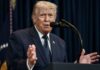


BREAKING UPDATE: TRUMP HAS CANCELED TODAY’S CAMP DAVID MEETING AND WILL HOLD IT AT THE WHITE HOUSE.
The real story behind Trump’s rare Camp David Cabinet meeting is not just Iran diplomacy, but how power, secrecy, and symbolism collide when Washington says talks are “proceeding nicely” and refuses to show its hand.
Story Snapshot
- Trump is convening a rare, full Cabinet meeting at Camp David as Iran negotiations reach what multiple outlets call a “critical” phase.
- Supporters see an urgent strategy huddle that could shape ceasefire terms, energy markets, and the Strait of Hormuz.[2][5]
- Skeptics argue the location and drama may be more about optics than a confirmed breakthrough.[1][3]
- The gap between what the White House says publicly and what this moment could mean is where media narratives and common sense clash.[1][2]
Camp David Is The Signal Everyone Is Reading Into
Trump is not dragging his entire Cabinet out to Camp David for a photo-op in the Rose Garden; this is a rare off-site session at the most symbolically charged retreat in American politics.[1][3] The White House’s own history page calls Camp David the president’s country residence and highlights its long use for sensitive meetings with foreign leaders, including Winston Churchill in World War II.[3] When a president chooses this wooded bunker over the West Wing, the political class starts looking for inflection points.
News outlets across the spectrum are doing exactly that. Gulf-based coverage flatly frames Wednesday’s gathering as a “rare Camp David cabinet meeting” coming at one of the most critical moments of Trump’s second term, with Iran talks under strain and the Strait of Hormuz partially blocked by conflict-related disruptions.[2] Iran-focused reporting similarly says the meeting comes “as talks with Iran near a critical stage,” explicitly linking the timing to the negotiations’ trajectory.[5] Those are strong phrases to attach to what the White House could have called a simple retreat.
President Trump is expected to take the unusual step of holding a Cabinet meeting at Camp David on Wednesday, The Washington Times has confirmed. https://t.co/CDCGgU4fnr
— The Washington Times (@WashTimes) May 26, 2026
Official Story: Routine Wins And A Calm President
The on-record description from a White House official sounds almost boring by comparison: the Cabinet will review “recent successes of the administration including economy and small business wins, Task Force to Eliminate Fraud highlights, and foreign policy updates.”[1] That kind of agenda could easily fit a mid-year offsite at any administration. The same official noted the whole Camp David plan is even weather contingent, since Trump usually travels there by helicopter.[1] On its face, this language tries to downplay drama, not sell a blockbuster summit.
CBS News still underscored that the meeting “comes amid negotiations with Iran for a peace deal,” and reminded viewers that Trump insists talks are going “nicely,” while also posting that he wants a “good deal or no deal at all.”[1] That combination—soft reassurance plus hardline caveat—fits his long-running brand: project confidence, keep leverage, and never look like you need the agreement more than the other side. To a conservative reader, that stance is far preferable to the “any deal is better than no deal” posture that defined too many Western negotiations with Tehran in the past.
Media Narrative: Critical Phase Or Manufactured Urgency?
Foreign and regional outlets are not subtle about the framing. One Gulf report bluntly says Trump will gather his full Cabinet “as the White House faces mounting pressure to secure a breakthrough in fragile Iran negotiations and reopen the Strait of Hormuz after fresh US strikes sharply raised tensions.”[2] The same piece warns that ceasefire talks are under strain, oil markets are rattled, and fears are rising that diplomacy could unravel.[2] That is crisis language used before any public readout of decisions.
Iran-focused coverage tracks closely: Trump is expected to hold the Camp David meeting “as talks with Iran near a critical stage,” suggesting a moment when concessions, deadlines, or military options may be on the table.[5] Yet none of these reports present a primary-source agenda, transcript, or binding decision. They rely on timing, location, and unnamed officials to infer that a turning point has arrived.[2][5] From a common-sense conservative view, that is where healthy skepticism should kick in: a rare venue proves seriousness, not necessarily a breakthrough or a sellout.
Symbolism, Leverage, And What Camp David Really Tells Us
The White House’s own description of Camp David reminds readers that presidents have used it “extensively” to host foreign dignitaries and conduct private diplomacy.[3] That history makes the venue a kind of narrative accelerant. Announce a Camp David meeting and commentators instantly reach for analogies to past peace deals or war councils. Coverage of a previous Trump-era Camp David strategy session on Iran and Gaza already portrayed that setting as where “his entire top foreign policy team huddled” to discuss nuclear and war strategy.[5]
Trump to convene rare Camp David Cabinet meeting amid rising Iran tensionshttps://t.co/30R04msxcO
— ABC 33/40 News (@abc3340) May 26, 2026
This pattern repeats now. Reporters talk about a “rare” Cabinet session, a “critical” stage of talks, and an administration under pressure to secure a peace breakthrough.[1][2][5] None of that guarantees a grand bargain; it does tell you the president wants maximum strategic flexibility with minimum public constraint. For readers who remember how past administrations leaked every micro-step of Iran talks, this tighter, Camp David-centered approach can look like a welcome correction: negotiate hard, behind closed doors, then present results to the country, not half-baked trial balloons.
Sources:
[1] Web – Trump calls rare Camp David Cabinet meeting amid critical Iran talks
[2] Web – 2025–2026 Iran–United States negotiations – Wikipedia
[3] Web – Camp David – The White House
[5] Web – Trump discussed Gaza, Iran goals at Camp David strategy session