

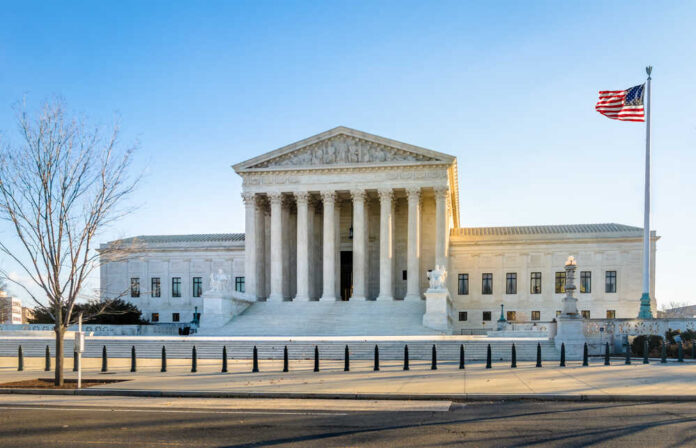
The Supreme Court did not just leave a $5 million verdict against President Donald Trump in place; it quietly locked in a legal story about power, sex, and speech that will follow every future president into the courtroom.
Story Snapshot
- A New York jury found Trump liable for sexually abusing and defaming E. Jean Carroll, awarding her $5 million.
- Federal judges later said her account of “rape” was substantially true in the everyday sense of the word.
- The Second Circuit Court of Appeals upheld the verdict and the way the trial was run.
- The Supreme Court refused to hear Trump’s final appeal, making the verdict legally final and politically inescapable.
How an Old Department Store Encounter Became a Modern Constitutional Fight
In the mid‑1990s, E. Jean Carroll says she met Donald Trump at Bergdorf Goodman, a luxury store in Manhattan. Both were public figures in New York’s social world. She testified that what began as playful banter over buying a gift turned dark in a dressing room.
There, she said Trump pinned her against a wall, kissed her, pulled down her tights, and penetrated her with his fingers as she tried to fight him off. There were no cameras, no security guards, and no police report.[1][3]
For years, Carroll did not sue. The statute of limitations for criminal charges was long gone by the time she went public. When Trump called her story a hoax and said she was lying, she turned to the one tool left: a civil lawsuit for sexual battery and defamation.
That choice matters. American law now often sorts claims against powerful men through civil defamation and battery suits when criminal systems are unavailable or unwilling. It is not a perfect path to truth, but it is the only path many accusers ever get.[3][14]
What the Jury Actually Decided, and What It Refused to Say
In 2023, a federal jury in New York held Trump liable for sexually abusing Carroll and for defaming her with his October 2022 social media post. Jurors did not find that Carroll proved “rape” under New York’s narrow criminal code.
They did find that Trump engaged in sexual abuse and forcible touching and that he lied about her with actual malice, meaning he either knew his denials were false or recklessly ignored the truth. The jury awarded her $5 million in total damages.[1][3][16]
Trump’s allies seized on the “not rape under New York law” line like a lifeboat. Judge Lewis Kaplan then punctured it. In a later ruling, he wrote that Carroll’s account described rape as most people use the word: deliberate, forcible penetration with his fingers.
Legally, the jury label was “sexual abuse.” Socially, morally, and in ordinary English, the court said, the conduct was rape.
Why Other Women, an Old Tape, and No Trump Testimony Still Passed Appeal
Trump skipped the trial and never took the stand. His lawyers argued later that the deck was stacked against him. They said the judge broke evidence rules by letting two other women testify about alleged past assaults and by letting jurors see the 2005 “Access Hollywood” recording where Trump bragged about grabbing women without consent.
They warned that such evidence inflames a jury and risks punishing a man for being unpopular rather than for what he allegedly did in one dressing room.[1][8]
The Second Circuit Court of Appeals was not persuaded. It upheld the verdict and the $5 million award in late 2024. The appeals court said the trial judge stayed within the rules by admitting evidence of other alleged sexual assaults under federal rules that permit such proof in sexual assault cases.
The court also ruled that the tape was relevant to Trump’s own view of grabbing women without consent, not just raw character assassination. In plain terms, the appeals judges said: you may not like this evidence, but the law allows it, and any close calls did not change the outcome.[8]
What the Supreme Court’s Silence Says About Power, Presidents, and Speech
By the time Trump reached the Supreme Court, his legal team framed the case as bigger than one verdict. They argued that the trial turned into a political sideshow and that the admission of past accusations and the tape created unfair bias.
They wanted the justices to say federal courts had gone too far in shaming a president over decades‑old claims built on one woman’s memory and no physical proof.[1][12]
President Donald Trump said he will continue fighting what he called a fake case after the Supreme Court declined to hear his appeal of a $5 million civil judgment in favor of writer E. Jean Carroll. https://t.co/rQYRblYY1y
— NEWSMAX (@NEWSMAX) June 29, 2026
The Supreme Court declined to hear the appeal in June 2026, without comment, leaving the $5 million verdict in place. That silence speaks. The justices did not endorse every word Judge Kaplan wrote. They did something more limited but more powerful: they refused to turn this case into a constitutional shield for presidents who speak recklessly about private citizens.
Sources:
[1] Web – Supreme Court rejects Trump’s push to toss $5 million verdict in E. …
[2] Web – Jury finds Trump liable for sexual abuse, awards accuser $5M
[3] Web – Supreme Court Lets $5 Million Sex Abuse Verdict Against Trump …
[4] Web – E. Jean Carroll v. Donald J. Trump – Wikipedia
[6] Web – CARROLL v. TRUMP (2023) – FindLaw Caselaw
[7] YouTube – Supreme Court Rejects Trump Appeal in E. Jean Carroll …
[8] Web – Carroll v. Trump, No. 23-793 (2d Cir. 2024) – Justia Law
[12] YouTube – U.S. Supreme Court rejects Trump’s appeal in E. Jean Carroll case
[14] Web – The Supreme Court declined to hear President Donald Trump’s …
[16] Web – Public Officials in Defamation Legal Claims – Justia