

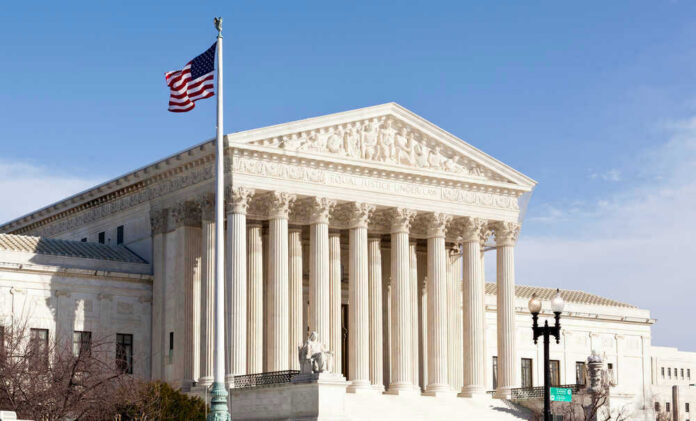
One unsigned Supreme Court order just turned Alabama’s 2026 election calendar into a moving target—and quietly raised the bar for challenging maps nationwide.
Quick Take
- The Supreme Court, by a 6-3 order, cleared a path for Alabama to use its 2023 congressional map again and sent the case back to lower courts.
- The order hinges on the Court’s April 2026 Louisiana v. Callais decision, which tightened what plaintiffs must prove under Section 2 of the Voting Rights Act.
- Alabama’s new election law anticipates the whiplash: some May 19 primaries in affected districts will be voided, with new elections scheduled later.
- The practical stakes include a likely shift from a 5R-2D delegation toward a 6R-1D outcome if the 2023 map governs 2026.
The 6-3 order that changed Alabama’s map days before primaries
The U.S. Supreme Court stepped in on May 11, 2026, vacating lower-court rulings that had blocked Alabama from using its 2023 Legislature-drawn congressional map.
The Court did not issue a signed majority opinion; it remanded the dispute for reconsideration under Louisiana v. Callais, decided in April. Timing mattered: Alabama’s primary calendar sat days away, and some campaign plans suddenly faced a legal rug-pull.
The immediate effect is procedural but potent: the 2023 map is no longer frozen out by the prior injunctions. That does not guarantee Alabama’s final victory in the lower courts, but it changes the playing field, because Callais reshapes the lens lower judges must use.
When the Supreme Court signals a new legal test, it’s a warning flare to every trial court: re-check your work, and do it fast.
How Alabama got here: Milligan, a court-drawn map, then Callais
Alabama’s redistricting fight traces back to the post-2020 census map adopted in 2021 and then challenged under Section 2 of the Voting Rights Act.
In 2023, Allen v. Milligan looked like a stabilizing moment; a 5-4 Court concluded challengers were likely right that the 2021 map diluted Black voting power.
Alabama redrew lines anyway, but lower courts rejected that remedial effort and imposed a map used for 2024 with two majority-Black districts.
The U.S. Supreme Court has set the stage for Alabama to get rid of one of two largely Black congressional districts before this year’s midterm elections. https://t.co/ipnrU3l7k2
— The Seattle Times (@seattletimes) May 11, 2026
Callais changed the temperature. The April 2026 ruling, arising from Louisiana, elevated the threshold for what counts as a legally required “opportunity district” under Section 2 and sharpened the Court’s skepticism toward race-centered line drawing.
That posture matters for those who value clear rules and equal treatment under law: if courts require states to sort voters by race to satisfy Section 2, they risk creating the very constitutional problems the Court has flagged for decades.
What the 2026 disruption looks like for voters and candidates
Alabama lawmakers anticipated the possibility that the Supreme Court would greenlight the 2023 map in time to scramble the election schedule. The state passed a bill delaying primaries and authorizing special elections if the 2023 lines came back into play.
Under that framework, some May 19 primary results in affected districts will be voided, with new elections scheduled afterward. For voters, it’s disorienting: the district you thought you lived in can shift midstream.
Election integrity depends on rules that stay put long enough for ordinary people to follow them. Courts and legislatures both bear responsibility here. Judges should avoid last-minute changes whenever possible, but states also shouldn’t treat calendars like flexible suggestions.
It says both sides have failed that standard at different points. The Supreme Court’s late order may be legally defensible under its new precedent, but the human cost is confusion and diluted confidence.
The political math: why a single district draws national attention
Alabama sends seven members to the U.S. House, so a one-seat shift can matter in a tight Congress. The court-drawn map used for 2024 produced a 5R-2D delegation.
Analysts expect the 2023 Legislature map, with one majority-Black district out of seven, to favor a 6R-1D split, potentially putting a Democrat-held seat at risk in 2026. That is why national groups treat Alabama like a chess square, not just a state dispute.
Redistricting incentives are brutally rational: politicians draw lines to win, then litigate to keep them. Some tend to argue that elected legislatures should make these choices, not federal judges, because accountability belongs at the ballot box.
The counterargument is that without firm federal standards, the majority can entrench itself. The Supreme Court’s recent direction suggests it prefers clearer constitutional boundaries over open-ended Section 2 mandates.
The bigger signal: Section 2 claims face a steeper climb after Callais
Callais reverberates beyond Alabama because it affects the core playbook of modern Voting Rights Act litigation. Section 2 vote-dilution cases typically rely on showing that a minority community is large and cohesive enough to form a district and that bloc voting by others routinely defeats their preferred candidates.
By tightening what plaintiffs must prove and by increasing skepticism of race-conscious remedies, the Court makes aggressive challenges riskier and slower.
That shift will please Americans who worry the law has drifted into an expectation of proportional representation by race, which the Constitution does not promise.
It will alarm Americans who see Section 2 as the last practical tool for ensuring minority voters can elect candidates of choice in places with polarized voting.
Both instincts exist in good faith. The immediate question is simpler: can lower courts apply the new standard quickly enough to avoid repeated election churn?
Alabama’s remanded cases now sit in that tension between legal theory and election administration. If lower courts again reject the 2023 map, the state could face another redraw under a ticking clock.
If they uphold it, other states will read the decision as a green light to defend legislature-drawn maps and to resist court-imposed “second districts” built around racial data. Either way, the 2026 midterms will arrive with a new rulebook.
Sources:
Supreme Court clears the way for Alabama to redraw congressional map
Supreme Court clears path for Alabama to redraw congressional map
SCOTUS greenlights 11th-hour Alabama redistricting plan for 2026 election
Supreme Court allows Alabama GOP to erase Black House district
Supreme Court opens door for Alabama to potentially redraw congressional map