

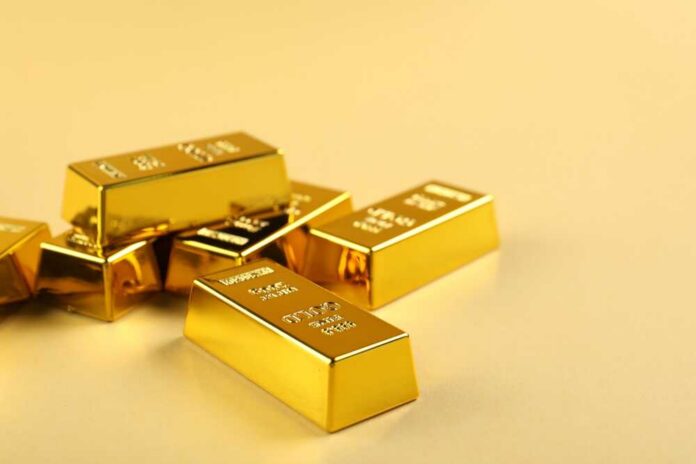
Gold just hit its lowest price in more than a year, and the reason is simpler than Wall Street wants to admit: inflation keeps winning.
Story Snapshot
- Spot gold fell 2% to $3,483.59 per ounce, its lowest level since September 2025.
- December gold futures dropped 2.3% to $3,482.50 per ounce the same day.
- The October Personal Consumption Expenditures price index rose 0.3% after a 0.5% jump in September.
- Traders now fully expect the Federal Reserve to raise rates by a quarter point in December.
Inflation Data Sends Gold Tumbling Again
Gold sank to its lowest price in more than a year on November 25 after fresh government data showed inflation kept climbing. Spot gold dropped 2% to $3,483.59 per ounce, a level not seen since September 2025. The Commerce Department’s Bureau of Economic Analysis reported the October Personal Consumption Expenditures price index rose 0.3% month over month, following a 0.5% increase in September.
December gold futures told the same story. They fell 2.3% to $3,482.50 per ounce, confirming the drop wasn’t limited to one corner of the market. For everyday Americans watching their retirement accounts or thinking about buying jewelry, the message is blunt. Inflation isn’t cooling off the way officials once promised, and gold investors are pricing in more pain ahead.
Why Rising Prices Push Gold Down, Not Up
It sounds backwards. Shouldn’t gold rise when inflation rises? Not when the Federal Reserve responds by hiking interest rates. Higher rates mean investors can earn more from bonds and savings accounts. Gold pays no interest at all, so it becomes less attractive the moment safer assets start paying more. That’s exactly what happened here.
Traders were fully pricing in a quarter-point rate hike for December after the inflation numbers came out. New York Federal Reserve President John Williams said persistently high inflation points toward tighter policy, though he noted any decision still depends on incoming data. When investors believe the Fed will keep squeezing rates higher, gold loses its shine fast, and that’s what markets just showed us.
A Second Inflation Shock Hit Gold Even Harder
This wasn’t gold’s only rough patch this fall. Earlier reporting tied to October Consumer Price Index data showed an even sharper drop. That report found prices rose 0.4% month over month, beating the 0.3% forecast, while core inflation came in at 0.3% against an expected 0.2%. Spot gold fell 2.62% to $4,030.56 per ounce after that release.
Two separate inflation reports, two separate gold selloffs, both pointing the same direction. Economic research backs up why this keeps happening. Studies from the Chicago Federal Reserve show gold is highly sensitive to real interest rates, estimating that a one-percentage-point rise in long-term real rates is tied to a 13.1% drop in real gold prices. Inflation surprises that push rates higher tend to drag gold down with them, not lift it up.
More Than Inflation Numbers Are Weighing on the Metal
Inflation data didn’t act alone. A stronger U.S. dollar and rising Treasury yields added extra pressure on gold the same week, part of a broader pattern of investor repositioning tied to rate-hike bets. Gold had already touched a 14-month low days earlier as that dollar strength combined with hawkish Fed expectations to squeeze the metal from multiple directions at once.
For conservative-minded readers who’ve watched inflation erode paychecks for years, this data confirms what kitchen-table budgets already know. The Fed’s fight against inflation isn’t over, and markets are adjusting in real time. Gold’s drop isn’t a mystery or a conspiracy. It’s a rational response to a Federal Reserve still wrestling with prices that refuse to fall as fast as promised.
🥇 Gold fell below $3,500 today for the first time since September 2025.
The trigger was US inflation.
Core PCE rose to 3.3% in October, against a 3.2% forecast and 3.1% in September.
Headline PCE came in at 3.8%.
Spot gold dropped 3% to $3,446, its lowest since August… pic.twitter.com/yImPQbJmsS
— Jack Prandelli (@jackprandelli) November 25, 2026
Investors watching gold now face a straightforward calculation. If inflation keeps running hot and the Fed keeps hiking, non-yielding assets like gold will likely stay under pressure into the new year. That’s not speculation. It’s the same mechanism that just played out twice in a matter of weeks, backed by Commerce Department data and confirmed in both spot and futures markets.
Sources:
cnbc.com, limpidmarkets.co.uk, sacbee.com