
A man hired to quietly scroll President Trump’s words allegedly turned those words into a six‑figure side hustle.
Story Snapshot
- Gabriel Perez, Trump’s longtime teleprompter operator, is under federal investigation over Kalshi bets tied to Trump speeches.
- Kalshi’s own surveillance flagged his trades as suspicious and froze profits reported around $90,000 to $100,000.
- Perez allegedly wagered on “mention markets,” using advance access to prepared remarks and even tweaking bets mid-speech.
- Prosecutors passed on criminal charges, but regulators are pushing civil penalties as prediction markets become the new insider battlefield.
The teleprompter operator who found a new way to cash in
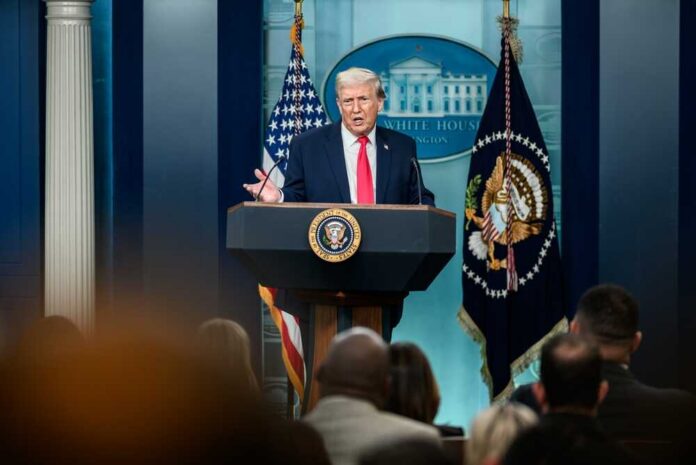
Gabriel Perez spent years in the shadows of President Trump’s spotlight, standing near the cameras and screens that fed words to the former president. He was not a strategist, not a top adviser, just the guy who made sure the speech rolled by at the right pace.
According to ABC News, that simple job came with something powerful: early access to Trump’s prepared remarks for major events like the State of the Union and global forums.
On prediction platform Kalshi, this kind of early access can turn into money fast. Kalshi offers “mention markets” where users bet on which words or phrases a public figure will say during a speech.
Reporters and officials say Perez allegedly used this inside view to place targeted bets on Trump’s speeches over about three months, including high-profile addresses watched around the world. Those bets reportedly added up to more than a dozen speeches and a six-figure profit.
How Kalshi caught on and why regulators care
Kalshi did not stumble on this case by accident. The company says its surveillance system flagged Perez’s trading in March 2026 as suspicious after seeing his pattern and status as a federal government employee.
Kalshi then froze his account before he could withdraw more than $90,000 in profits and sent a referral to the Commodity Futures Trading Commission, the federal agency that polices prediction markets and similar platforms. That referral turned a private betting streak into a public insider trading investigation.
President Donald Trump's longtime teleprompter operator, Gabriel Perez, has drawn ire from the White House after reports he'd profited from Kalshi bets linked to content in Trump's speeches. https://t.co/kYWkQSjsD7
— Business Insider (@BusinessInsider) July 16, 2026
Sources say Perez admitted making some trades when he met with regulators. The investigation focuses on whether he abused nonpublic information gained through his job, which is exactly what insider trading laws target, even on prediction markets rather than traditional stocks.
This is believed to be the first known case of a White House employee being probed for insider trading on a prediction site. For Americans who assume insider trading only happens on Wall Street, that alone is a red flag.
Allegations of mid-speech maneuvering and the White House reaction
One detail that jumps out is the claim that Perez adjusted or exited bets while Trump was speaking. When Trump skipped certain prepared lines, sources say Perez changed his positions in real time, trying to dodge losses when expected phrases never came.
That kind of mid-speech maneuvering suggests more than casual guessing; it fits with a tight link between his job at the teleprompter and his bets on the same words.
The White House response was sharp and moralistic. Press Secretary Karoline Leavitt said Trump viewed the alleged conduct as “deeply unfortunate” and “a disgrace,” and confirmed Perez was placed on unpaid leave. Officials later said he would not be returning to work there.
From a common-sense view, this tracks: when you are trusted with the president’s words, turning that trust into a private betting scheme looks like a clear breach of duty, even before a judge weighs in.
No criminal charges, but a bigger insider problem
Despite the strong language, the Manhattan U.S. Attorney’s Office declined to open a criminal case after the CFTC referral. Perez is instead in civil settlement talks, which could mean paying back profits and facing trading bans without a formal court ruling that he committed insider trading.
His lawyers can argue that lack of criminal charges shows the evidence is not ironclad. But from a broader perspective, the pattern is bigger than one teleprompter operator.
Trump’s teleprompter operator is under investigation for betting on what Trump would say.
Kalshi let traders bet on exact words in presidential speeches. It froze more than $90,000 in profits and referred the trades to the CFTC. pic.twitter.com/WUXU9uYS13
— The Fifth Signal (@TheFifthSignal) July 19, 2026
In 2026 alone, regulators and reporters have tracked multiple cases where government insiders used nonpublic information on prediction markets, including an Army soldier indicted for using classified military data to win hundreds of thousands of dollars on Polymarket.
The White House has already warned staff not to use confidential war or policy information to trade or bet. States like New York are moving to ban employees from exploiting nonpublic data on these platforms.
What this means for trust, politics, and your gut instinct
For many voters, the Perez story feels less like a shock and more like confirmation. Regular Americans go to work, follow rules, and pay taxes. Yet people near power keep finding new ways to skim money off the system, whether through stock trades, speaking fees, or now prediction markets.
Those who talk about character and duty see this kind of alleged behavior as proof that ethics training alone is not enough; you also need consequences that sting.
Kalshi’s quick referral shows private platforms can police their own users when money and politics mix. But the fact that a teleprompter operator could allegedly make close to $100,000 before getting caught raises a simple question: how many others are doing the same thing and staying under the radar?
As prediction markets spread, this story is less about one man at a teleprompter and more about whether public servants treat insider knowledge as a trust, or as a lottery ticket they feel entitled to cash.
Sources:
cbsnews.com, reuters.com, gate.com, license.aiying.cc, facebook.com, news.bitcoin.com, pillsburylaw.com, nytimes.com, bankchampaign.com, nbcnews.com, usnews.com, kslaw.com, debevoise.com