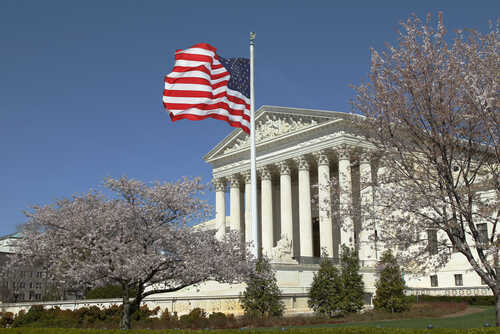
The Supreme Court handed Alabama Republicans a major legal victory, overruling a lower court and clearing the state to use its legislature-drawn congressional map for the 2026 elections — leaving Democrats and Justice Sonia Sotomayor furious.
Story Snapshot
- The Supreme Court lifted a lower-court block and allowed Alabama to use its 2023 congressional map featuring one majority-Black district.
- A federal three-judge panel had previously ruled the Republican-drawn map intentionally discriminated based on race and blocked its use.
- The ruling is the latest chapter in a years-long redistricting battle rooted in Alabama’s 2021 congressional map, which the Court earlier found likely violated the Voting Rights Act.
- Justice Sotomayor dissented sharply, while Democrats expressed frustration over another Supreme Court setback on redistricting.
Supreme Court Clears Alabama’s Map for Elections
The U.S. Supreme Court ruled that Alabama may proceed with its 2023 congressional map — one that contains a single majority-Black district — for this year’s elections.
The decision reversed a lower court’s order that had blocked the map from being used. The high court’s action allows the Republican-backed plan to govern congressional races while litigation over the map’s long-term legality continues through the courts.
BREAKING — The U.S. Supreme Court allows Alabama to use the new 6R-1D congressional map for the midterm elections.
🔴 +1 GOP
🔵 -1 DEM pic.twitter.com/UZtpM9eeUN— VoteHub (@VoteHub) June 3, 2026
This redistricting fight has stretched across multiple election cycles and court levels. Alabama’s 2021 map was previously challenged under Section 2 of the Voting Rights Act of 1965, which prohibits voting practices that discriminate on the basis of race.
The Supreme Court’s earlier ruling in Allen v. Milligan found that the 2021 map likely diluted Black voting strength by concentrating too few Black voters into a single district. Alabama’s legislature responded by enacting the 2023 map, which critics argue failed to meaningfully address those concerns.
Lower Court Had Blocked the Map as Discriminatory
Before the Supreme Court intervened, a federal three-judge panel blocked Alabama’s 2023 map and ruled it unconstitutional.
The panel found the Republican-drawn plan intentionally discriminated based on race and concluded the legislature “well knew” that a map without an additional majority-Black district would dilute Black Alabamians’ opportunity to participate in the political process. That ruling set up the emergency appeal to the Supreme Court that ultimately produced this week’s order.
These redistricting disputes frequently become time-sensitive emergency litigation because election calendars force courts to decide map validity before ballots are printed.
The Supreme Court has repeatedly stepped in through interim orders in such cases — orders that resolve the immediate practical question of which map to use without necessarily settling the underlying constitutional merits. The Alabama case fits squarely into that recurring pattern of last-minute judicial intervention ahead of election deadlines.
What This Means for Alabama’s Congressional Races
With the Supreme Court’s order in place, Alabama will conduct its 2026 congressional elections under the legislature’s 2023 map. That map draws one majority-Black district out of the state’s seven congressional seats.
Republicans have argued the map complies with the law and reflects legitimate legislative judgment about how to draw district lines. The underlying litigation, however, is not resolved — the legal battle over whether the map ultimately satisfies federal voting-rights requirements will continue in lower courts.
Supreme Court allows Alabama to use congressional map favoring Republicans in this year's electionshttps://t.co/VfhhmFkX4l
— MyCuzzin Vinni, Esq. (@mycuzzinvinni) June 3, 2026
For conservatives, the ruling reinforces a straightforward principle: state legislatures, not federal judges, should have primary authority over how congressional districts are drawn. Courts stepping in to mandate specific racial compositions in districts raises serious questions about equal protection and the limits of judicial power.
Alabama’s legislature drew a map, enacted it through the proper democratic process, and the Supreme Court has now allowed voters to be represented under that map while the legal process plays out — exactly how the system is supposed to work.
Sources:
[1] Web – BREAKING: Supreme Court Allows Alabama to Use Congressional Map that …
[2] YouTube – Supreme Court allows Alabama to use congressional map with one …
[3] YouTube – Alabama asks Supreme Court to allow use of congressional map …
[4] YouTube – Supreme Court rules on Alabama congressional map
[5] Web – Supreme Court halts order for Alabama to use US House map with 2 …
[6] YouTube – Supreme Court reinstates Alabama congressional map
[7] Web – What’s Happening with Alabama’s Redistricting Post-Milligan?
[8] YouTube – Supreme Court overturns 2023 ruling on congressional map in …