
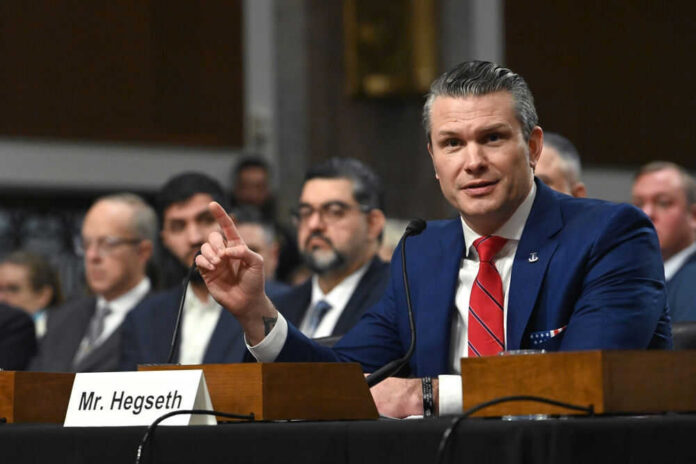
Pete Hegseth’s order to remove a respected Army communications leader is forcing a hard question: are Pentagon personnel decisions now being driven more by past loyalties than performance?
Story Snapshot
- Pentagon Secretary Pete Hegseth directed Army Secretary Dan Driscoll to remove Col. Dave Butler as Chief of Army Public Affairs and Driscoll’s top adviser.
- Butler chose retirement after 28 years rather than fight the removal, even though he had been slated for brigadier general.
- Reporting ties Butler’s vulnerability to his prior role as spokesman for retired Gen. Mark Milley, a frequent Trump-era flashpoint.
- The move lands amid a wider series of senior-leader firings that multiple outlets describe as creating fear and uncertainty inside the officer corps.
What Happened: A Sudden Removal While the Army Secretary Was Overseas
Pentagon Secretary Pete Hegseth ordered Army Secretary Dan Driscoll to remove Col. Dave Butler from two influential roles: chief of Army public affairs and chief adviser to Driscoll.
Multiple reports place the order in mid-February 2026, delivered while Driscoll was in Geneva working as part of a Ukraine negotiating team. The timing mattered, because the same reporting says Driscoll had resisted pressure for months to push Butler out.
War Secretary Pete Hegseth has ordered the removal of a senior Army public affairs official who previously served under former Joint Chiefs Chair Mark Milley, according to reports. pic.twitter.com/fzBnsPAjFE
— NEWSMAX (@NEWSMAX) February 17, 2026
Butler’s exit quickly became a retirement announcement, not a public disciplinary action. Driscoll issued a statement praising Butler’s “lifetime of service” and pointing to his role in the Army’s transformation efforts, while avoiding details about the order itself.
That careful phrasing signals how tense this dispute may be inside the Pentagon: the Army’s top civilian leader publicly commended an officer he was simultaneously compelled to remove.
Why Butler Was in the Crosshairs: The Milley Connection and a Promotion Bottleneck
Reporting points to Butler’s prior association with retired Gen. Mark Milley as a key factor in why he was targeted. Butler previously served as Milley’s chief spokesman and also worked as a communications director for U.S. and NATO forces in Afghanistan in 2018–2019.
Milley, after retiring, became a sharp critic of President Trump, and the administration has taken multiple actions affecting Milley, including changes to his security posture and symbolic removals.
Butler’s pending promotion added another layer to the dispute. His name appeared for two consecutive years on an Army promotion list that included 34 officers selected for brigadier general.
Reports also say Hegseth had held up the promotion list for nearly four months, citing concerns about a small number of officers on it. Butler even offered to withdraw his name to prevent other officers from being delayed—an unusual step that underscores how high the internal friction had become.
Broader Pattern: Senior Firings, Unclear Rationales, and the Risk to Candid Military Advice
Butler’s removal did not happen in isolation. The same coverage describes a broader pattern of unexplained firings and leadership changes affecting senior military figures across services and key defense roles.
Names cited in reports include top uniformed positions in the Navy, Air Force, and joint structures, plus intelligence-related leadership posts. Outlets characterizing the environment describe fear and uncertainty among senior leaders—conditions that can discourage frank, professional advice when civilian leaders most need it.
From a conservative perspective, accountability and civilian control are non-negotiable, but so is competence and continuity—especially during global instability and delicate negotiations.
If personnel decisions are perceived as driven by association rather than measurable performance, commanders may self-censor, avoid hard truths, or prioritize career survival over mission clarity. The research available does not provide any official, detailed rationale from Hegseth for Butler’s removal, which leaves the public evaluating intent through inference.
What This Means for the Army’s Message and Reform Agenda
Army public affairs is not window dressing; it shapes how Americans understand readiness, recruiting, modernization, and warfighting culture. Driscoll’s statement credited Butler as integral to Army transformation efforts, and one former four-star commander reportedly called Butler the most competent public affairs officer he had worked with.
If those assessments are accurate, the Army loses an experienced communicator at a time when public trust, recruiting challenges, and global threats demand crisp, credible messaging.
Politically, the episode also spotlights a quiet power struggle between the Pentagon’s civilian leadership layers. Driscoll is described as a close ally of Vice President JD Vance, and he reportedly resisted the removal push for months.
Butler ultimately chose retirement, but the larger question remains unresolved: whether the Pentagon will clarify objective standards for removals and promotions, or whether the officer corps will continue operating under uncertainty about what, beyond performance, determines career survival.
Sources:
Pete Hegseth pushes out Army chief of public affairs Dave Butler
SCOOP: Hegseth orders removal of Army public affairs chief amid broader Pentagon purge
Hegseth Forces Out Senior Pentagon Public Affairs Officer
Hegseth Orders Removal of Army Public Affairs Chief Amid Broader Pentagon Purge