

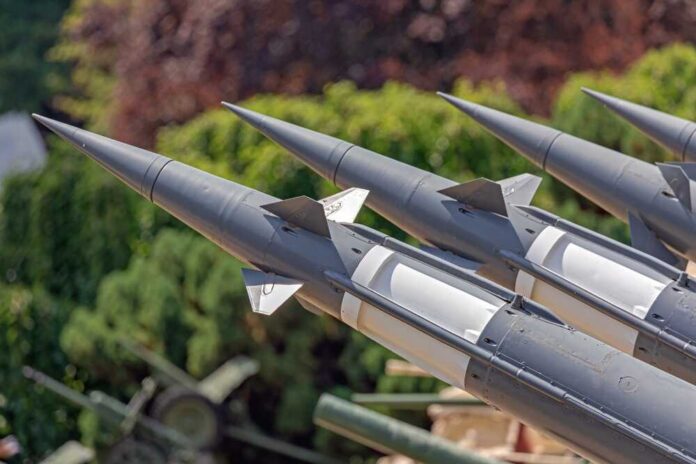
America just fought and won a war with Iran using high-tech missiles so fast and in such huge numbers that it burned through nearly half of some of its most prized long-range weapons, raising a blunt question: what happens if the next crisis hits before the shelves are restocked.
Story Snapshot
- The United States used at least 45 percent of its Precision Strike Missiles in the Iran war.
- Experts say rebuilding key missile stocks will take years, not weeks or months.
- Heavy use of Patriot and other air defense missiles created real strain on U.S. readiness.
- The war exposed a gap between American power on paper and what the arsenal can sustain in practice.
How the Iran war chewed through America’s long-range missiles
The Iran war did not move slowly or politely; it opened with a missile sprint. U.S. forces fired thousands of offensive and defensive weapons in just the first weeks, including new long-range Precision Strike Missiles, Joint Air-to-Surface Standoff Missiles, Tomahawk cruise missiles, Patriot interceptors, and Terminal High Altitude Area Defense interceptors.
Analysts at the Center for Strategic and International Studies concluded that the United States expended at least 45 percent of its Precision Strike Missiles, a category designed to hit targets from long range with pinpoint accuracy. That level of use turned a cutting-edge program from a modernization win into a near-empty bin almost overnight.
U.S. has used 'virtually all' of its long-range precision missiles during Iran war: Reuters https://t.co/Hdd5oEHHXO
— CNBC (@CNBC) August 4, 2026
The pace did not only hit ground-attack weapons. Patriot air defense missile batteries and Terminal High Altitude Area Defense systems guarded U.S. bases, ships, and allies from Iranian ballistic missiles and drones, and they fired constantly.
Separate analyses found that the United States used roughly two-thirds of its pre-war Patriot interceptor inventory and similarly high shares of other missile defenses during the campaign. That is the kind of drawdown that does not grow back with a simple budget tweak, especially when each interceptor costs millions of dollars and relies on specialized factories with limited capacity.
Why replacing these missiles will take years, not months
Missile stockpiles are not like grocery shelves; they are closer to classic cars built by hand. The Center for Strategic and International Studies’ rebuilding study estimated that returning seven key missile types to pre-war levels will take between one and four years.
Joint Air-to-Surface Standoff Missiles and Precision Strike Missiles could take several months to a year, while land-attack cruise missiles like Tomahawk and major air defenses such as Patriot might require two to three years or more.
Defense Secretary Pete Hegseth summed it up bluntly, saying replenishment would take “months and years” depending on the system. That timeline means any fresh crisis could find the United States powerful but partially short on its best tools.
This slow rebuild is not some freak accident of the Iran war; it reflects deeper choices. The United States spent decades favoring fewer, more advanced missiles over larger, cheaper stocks.
That model works when wars are short or mostly theoretical. It breaks down when a real enemy launches large missile and drone salvos day after day and U.S. commanders must shoot back and shoot down to protect American troops and allies.
What this means for U.S. Army firepower and future wars
The United States Army did not just watch this war from the sidelines; it used the conflict as a live test for its new long-range Precision Strike Missile, which is a centerpiece of its long-range precision fires modernization plan.
One report described a U.S. Army unit expending all of its new Precision Strike Missiles at the start of the war, showing how quickly modern units can burn through advanced munitions when real targets appear.
The Congressional Research Service has stressed that these missiles are meant to reach deep into enemy territory, hitting command posts, air defenses, and launchers that threaten U.S. forces and allies. When almost half of that inventory disappears in one campaign, commanders in other theaters must start to ask hard questions.
Those questions are not abstract. Analysts warn that if another major war broke out soon, especially in the Indo-Pacific region, the United States could face near-term risk of running low on key long-range missiles and interceptors.
That matters because deterrence depends on unquestioned strength. Enemies must believe that if they strike, the United States can hit back with overwhelming force for as long as it takes. If missile magazines look thin, countries like China, Russia, or Iran may test the edges, probing for weak spots or betting that America will hesitate rather than risk emptying its arsenal again.
Opacity, spin, and the politics of a strained arsenal
Missile numbers rarely appear on public spreadsheets. The Department of Defense keeps detailed stockpile counts classified, which makes precise verification hard for citizens and even many lawmakers. Media outlets, think tanks, and defense industry voices filled that gap during the Iran war.
Center for Strategic and International Studies assessments, stories from major networks, and commentary from advocacy groups created a broad consensus that U.S. missile stocks are under stress and that rebuilding will require years of sustained effort.
While their methods rely in part on anonymous sources and estimates, their warnings align closely with internal Pentagon views described by officials who say the industrial base cannot ramp up fast enough to replace what was fired.
That mix of secrecy and outside analysis carries obvious risks. Short video clips and social posts often blur the lines between very different missile systems, turning a serious but specific problem with Precision Strike Missiles and Patriot interceptors into a vague sense that “America is running out of everything.”
At the same time, defense contractors and some think tanks have clear incentives to highlight shortages and long rebuild times, since urgency can drive bigger contracts and looser oversight.
The core lesson rings true: a superpower should not discover in the middle of a regional war that it lacks enough high-end missiles to fight the next one with confidence.
The Iran war was not only a clash with an enemy; it was a stress test of our own arsenal, and the results say the United States must rebuild, rethink, and re-prioritize before the next test arrives.
Sources:
youtube.com, cnn.com, businessinsider.com, congress.gov, militarnyi.com, heritage.org, americanmind.org, facebook.com, cronkitenews.azpbs.org, nytimes.com, reddit.com