
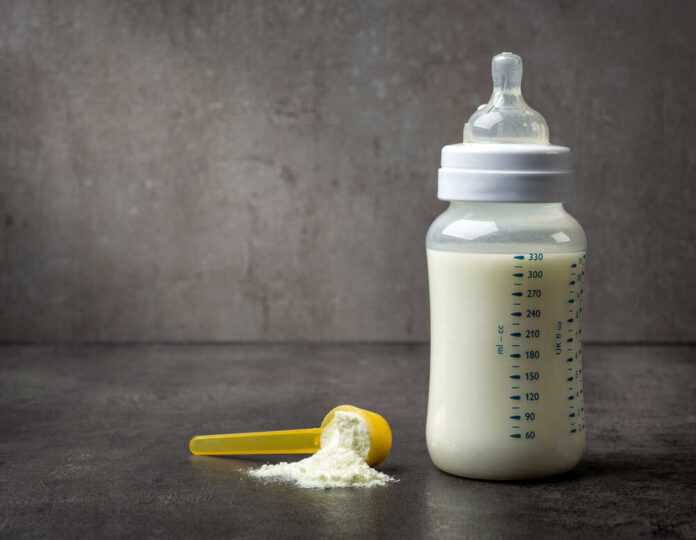
A familiar baby bottle on a Walmart shelf turned into a recall story because tiny bits of plastic may break loose where parents least expect trouble: at feeding time.
Quick Take
- TOMY recalled about 40,000 Boon NURSH 8-ounce reusable baby bottle three-packs sold at Walmart after 135 reports of bubbling or peeling of the outer plastic shell.
- The hazard is not cosmetic. The recall says that loose pieces of film-like plastic can pose a choking hazard for young children.[3]
- The affected product is the pink tie-dye three-pack sold exclusively at Walmart from November 2025 through May 2026.[2][3]
- No injuries had been reported in the available recall coverage, but the recall still proceeded because infant choking risk is treated as a serious public health issue.[1]
What Triggered the Recall
The core problem was a defect in the hard outer shell that could bubble, partially peel, or break into loose fragments.[3] Those fragments were described as small, film-like pieces that could be accessible to young children.[1][3]
That detail matters because a baby bottle does not need to fail catastrophically to become dangerous; it only needs to shed enough material for an infant to swallow or inhale it.
Popular baby bottles sold at Walmart recalled after 135 choking hazard reports https://t.co/30keXzLq14
— FOX Business (@FoxBusiness) June 5, 2026
The complaint count gives the recall weight. According to the U.S. Consumer Product Safety Commission, TOMY received 135 reports of bubbling or peeling in the outer shell.
That is a large enough cluster to move a defect from theory to action. Even without reported injuries, repeated consumer complaints can signal a pattern serious enough to justify pulling the product from the market before harm shows up in an emergency room.
Why the Packaging Details Matter
This was not a broad recall of every Boon bottle. The available reporting ties the action to the pink tie-dye three-pack of Boon NURSH 8-ounce reusable baby bottles, sold exclusively at Walmart.[2][3] The sales window was narrow as well, running from November 2025 through May 2026.[2][3]
That specificity is important because it tells parents what to look for and tells investigators where the defect likely lived in the supply chain.
Reporters also noted that the bottles were sold for about $20 and came in a three-pack.[2][3] Those are ordinary consumer details, but they help explain why the story spread fast: this was not a rare specialty item.
It was a mass-market infant product sold through a major retailer, which meant the recall affected many households and feeding routines at once.
How Serious Is a Recall With No Injuries?
No injuries had been reported in the materials provided, and that absence is both reassuring and misleading.[1] Reassuring because the defect had not yet produced a documented injury. Misleading because infant-product recalls often happen before injuries accumulate.
In plain terms, safety regulators do not need to wait for a child to choke before treating a breakaway plastic defect as a public hazard.
Loose plastic from a baby bottle
can choke a child.Boon NURSH 8 oz bottles recalled in the USA.
40000 units. 135 reports received.
Sold at Walmart Nov 2025 – May 2026. pic.twitter.com/fUXd08EcNZ— RecallScope (@RecallScope) June 6, 2026
That is why the recall reads as preventive rather than punitive. Consumers were told to stop using the bottles and contact TOMY for a replacement set or store credit.[1][2] Walmart was named the exclusive retail channel, but the defect itself was due to the product design, not the store shelf.
The real lesson is simpler and less comforting: a trusted product can look ordinary right up until its materials begin to fail in ways babies cannot guard against.
What Parents Should Notice Now
The most useful response is visual, not dramatic. Parents should check for the pink tie-dye three-pack and look for the hard plastic shell around the soft silicone pouch.[1][2] If the outer shell shows bubbling, peeling, or loose plastic, the bottle should be taken out of service immediately.[3]
Infant gear rewards caution, because the smallest loose part can become the biggest problem in the room.
The larger pattern behind this recall is familiar to anyone who follows consumer safety: repeated complaints, a clearly defined defect, and a product that reaches children before the damage becomes visible.[1]
That is why the headline matters beyond one bottle. It reminds parents that the most dangerous flaws are often not loud failures. They are quiet ones, the kind that begin as peeling plastic and end as a recall notice.
Sources:
[1] Web – Popular baby bottles sold at Walmart recalled after 135 choking hazard …
[2] Web – Recall alerts parents to baby bottle choking risk
[3] YouTube – Boon baby bottles recalled over choking hazard risk