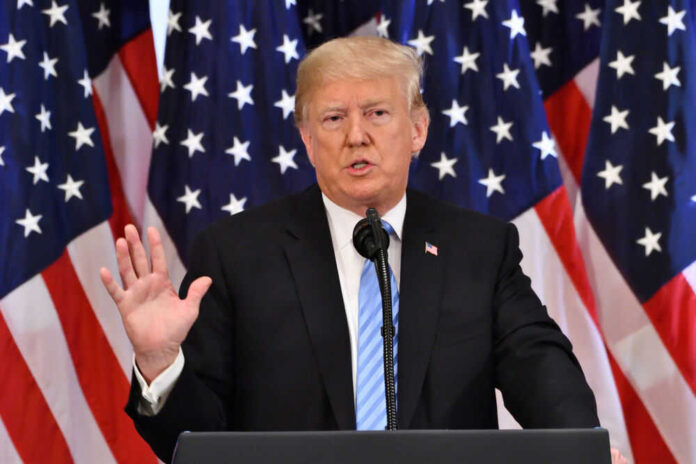
President Trump’s latest comments on European leadership highlight a growing divide, challenging decades-old alliances.
Story Highlights
- President Trump criticizes European leaders as “weak” amid strained relations.
- Comments coincide with ongoing efforts by Europe to support Ukraine.
- Trump’s stance signals a shift in traditional U.S.-European alliances.
- Europe’s security and diplomatic strategies face new challenges.
Trump’s Sharp Criticism of European Leadership
In a recent interview with Politico, President Trump labeled European leaders as “weak,” accusing them of heading a “decaying” region. This statement comes at a time when Europe is striving to project strength and unity, especially in its ongoing support for Ukraine.
Trump’s remarks have sparked outrage among his European allies, who have been actively involved in military, financial, and diplomatic efforts to aid Ukraine. Despite these actions, Trump remains skeptical of Europe’s ability to influence the outcome of the conflict.
Trump slams European leaders as 'weak' — just as they're trying to impress him https://t.co/xXDGA6VkWs
— CNBC (@CNBC) December 10, 2025
Implications for U.S.-European Relations
President Trump’s comments highlight a growing rift in U.S.-European relations, a change from the historically strong alliance. His recent national security strategy document suggests that a strong Europe may not align with U.S. interests.
This perspective has raised concerns across European capitals, as it challenges the collaborative efforts that have defined transatlantic relations since World War II. Analysts suggest that Trump’s approach could redefine the dynamics of international diplomacy, with potential repercussions for both sides.
Amid these tensions, European leaders continue to engage in discussions on Ukraine’s future, focusing on securing guarantees in any peace agreement. However, Trump’s nonchalant attitude towards these efforts underscores the challenges facing Europe’s diplomatic strategies.
The Future of Transatlantic Alliances
The evolving U.S. stance, as articulated by President Trump, may signal a seismic shift in transatlantic alliances.
With the U.S. questioning the reliability of European partners and advocating for renewed strategic stability with Russia, European nations are prompted to reassess their own security and diplomatic priorities.
This shift is seen as a wake-up call for Europe, urging it to bolster its unity and strategic autonomy in the face of changing global dynamics.
As Europe navigates these challenges, the future of its relationship with the U.S. remains uncertain, prompting discussions on how best to maintain a balanced and effective alliance.