

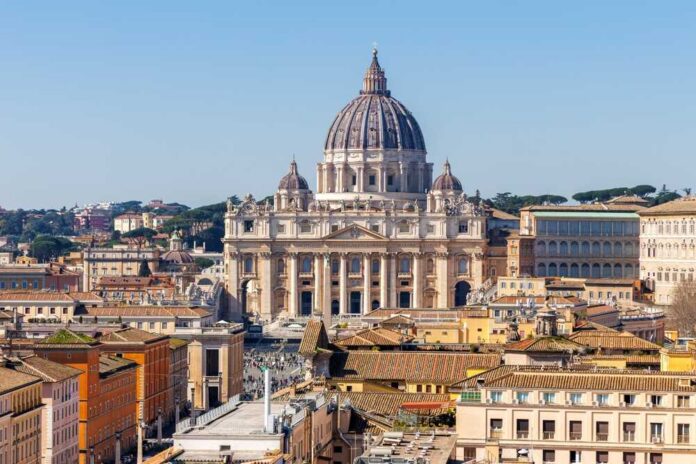
The Vatican is using artificial intelligence and modern technology to transform one of Christianity’s holiest sites into a 21st-century spiritual hub, marking four centuries since St. Peter’s Basilica was consecrated in 1626.
Story Highlights
- AI-powered real-time Mass translations in 60 languages will be available via QR codes without downloading apps
- Advanced geophysical monitoring reveals foundational vulnerabilities 38 feet below the basilica’s facade, prompting long-term preservation efforts
- Pope Leo XIV will celebrate a culminating Mass on November 18, 2026, exactly 400 years after Pope Urban VIII consecrated the basilica
- Expanded rooftop access, online reservations, and weekly spiritual events aim to enhance the pilgrim experience while reducing queue times
Vatican Embraces Technology for Historic Anniversary
Cardinal Mauro Gambetti announced sweeping modernization initiatives during a Vatican press conference celebrating St. Peter’s Basilica’s 400th consecration anniversary. The upgrades include partnerships with tech firm Translated for AI-powered Mass translations and energy company Eni for structural monitoring.
Unlike Pope Julius II’s controversial demolition of the original 4th-century basilica in 1506, these enhancements preserve the Renaissance masterpiece while addressing contemporary pilgrim needs.
The initiatives contrast sharply with the 109-year construction period from 1506 to 1615, when architects Bramante, Michelangelo, Maderno, and Bernini labored under successive popes to complete the world’s largest church by interior volume.
Cardinal Mauro Gambetti, Archpriest of St. Peter’s Basilica, announces several initiatives to mark the 400th anniversary of the Basilica’s dedication, including a multilingual platform for pilgrims and the launch of the new ‘Michelangelus’ font.https://t.co/mvRkKw2K0A
— Vatican News (@VaticanNews) February 16, 2026
AI Breaks Language Barriers for Global Worshipers
Pilgrims visiting St. Peter’s Basilica can access real-time Mass translations in 60 languages by scanning a simple QR code, eliminating the need for app downloads and other technical barriers.
This partnership between the Vatican’s Dicastery for Communication and Translated represents a practical application of AI that serves evangelization without compromising traditional worship.
The system addresses a fundamental challenge for the estimated millions of annual visitors from diverse linguistic backgrounds. By removing language obstacles, the Vatican demonstrates how technology can enhance rather than replace authentic spiritual experiences.
This approach respects individual access to worship while maintaining the basilica’s sacred atmosphere, a balance often lost in secular institutions’ rushed adoption of untested technologies.
Vatican expands visitor experience at St. Peter’s Basilica to mark 400th anniversaryhttps://t.co/eLh0wE5Ke0 pic.twitter.com/31VKOHKwWh
— The Washington Times (@WashTimes) February 16, 2026
Structural Monitoring Addresses Centuries-Old Foundation Concerns
The “Beyond the Visible” project conducted 4,500 hours of geophysical surveys over two months, revealing clay and gravel foundations 38 feet below the basilica’s facade. This feature has challenged architects since the 17th century.
Eni’s advanced monitoring technology aims to ensure structural stability for 250-plus years, addressing water table issues first noted by architect Carlo Maderno during the original construction.
This preventive approach prioritizes preservation over demolition, a sharp departure from Julius II’s decision to raze Constantine’s basilica. Cardinal Gambetti emphasized this contrast, positioning Pope Leo XIV’s administration as a steward rather than a builder.
The project sets a precedent for heritage sites worldwide, demonstrating responsible use of private-sector expertise to protect irreplaceable cultural treasures.
Expanded Access and Spiritual Programming Enhance Pilgrim Experience
Vatican officials doubled the rooftop snack bar’s capacity and implemented an online reservation system to reduce pilgrim queues while maintaining security and reverence.
Weekly “Spiritual Elevations” events, held every Saturday at 3:30 PM, feature the Cappella Giulia choir, lectures, and pilgrimage routes that connect visitors to the basilica’s 1,950-year history as the venerated burial site of St. Peter.
A temporary Stations of the Cross exhibit by Swiss artist Manuel Dürr, winner of a 2023 international competition, will be inaugurated on February 20 during Lent.
The “Bernini and the Barberini” exhibition from February 12 to June 14 celebrates sculptor Gian Lorenzo Bernini’s contributions under Pope Urban VIII, including the recently restored baldacchino. These initiatives boost economic activity for Rome while reinforcing the Vatican’s soft power through cultural-spiritual fusion.
Culminating Mass Honors Four Centuries of Sacred History
Pope Leo XIV will preside over a Mass on November 18, 2026, exactly 400 years after Pope Urban VIII consecrated the completed basilica following decades of construction challenges.
The anniversary programming includes theatrical performances about Saints Peter and Paul scheduled for June, immersive exhibits detailing the basilica’s construction, and lectures in November examining the basilica’s architectural and spiritual significance.
Cardinal Gambetti framed the anniversary as an “authentic event” in history, emphasizing renewed understanding of the basilica’s role in humanity’s relationship with the divine.
This comprehensive approach integrates education, worship, and cultural appreciation without succumbing to superficial modernization trends. The Vatican’s measured adoption of AI and monitoring technology demonstrates that tradition and innovation need not conflict when guided by clear purpose and respect for heritage.
Sources:
For its 400th anniversary, St. Peter’s Basilica to get 21st-century upgrade, Vatican announces
400 years of St Peter’s Basilica celebrated with Bernini exhibition
Bernini and the pope who promoted him celebrated as Vatican marks 400 years of St. Peter’s Basilica
The 400th anniversary of the dedication of St Peter’s Basilica